Saturday, January 26, 2019

The Odd Stem Cell Position of the Golden State: Hype, Hope and Dubious Clinics


The California stem cell agency and the Golden State's robust scientific stem cell community received some notice this week in the the Los Angeles Times, the state's largest circulation newspaper. 

It came in the form of an op-ed article that decried the booming business enjoyed by unregulated stem cell clinics, a field where California leads the nation. The Times says it has 1.4 million readers daily and 2.4 million on Sunday.

Usha Lee McFarling, a Pulitzer Prize-winning journalist and currently an artist in residence at the University of Washington, wrote the article discussing the issues surrounding the dubious clinics and their considerable risks, which do not seem to discourage those seeking help. She said,
"So why do patients keep streaming in for treatments that cost thousands of dollars? Part of the reason, I suspect, is that stem cell research — the serious, scientific kind — has gotten so much hype in recent years. We’ve all heard about how some stem cells have the power to become any type of cell in the body and might one day offer cures for all manner of crippling and degenerative diseases. If you can jump the line, and get those treatments now, why not do it? 
"Here’s why: Because the days of miraculous cures, if they come, are far in the future. Today, there is only one federally approved stem cell product: the limited use of blood-forming stem cells to treat certain blood disorders. Scientists are just beginning to learn how to harness the power of stem cells, and the harsh reality is that clinical trials that could turn that knowledge into effective therapies will take years, if not decades."
McFarling continued, 
"California is in an odd position. It is the state with the most stem cell clinics in the country offering these unproven 'cures.' It also happens to be a world center of serious scientific stem cell research, thanks to a $3-billion ballot initiative, Proposition 71, passed by voters in 2004 to fund research."
She noted the fledgling efforts at the state and national level to deal with the dubious clinics. McFarling wrote, 
"Here’s an idea in the meantime. The many scientists who have benefited from taxpayer support of stem cell research in the state should start speaking out. After all, the hype from proponents of Prop. 71 (which created the state stem cell agency) is part of what created such high expectations for quick cures – and eagerness on the part of patients to get them. Scientists should now take every opportunity both to explain to the public the long-term goals of their research and the absurdity of the so-called cures now flooding the market."
Our take: Her advice to California researchers is sound. However, it should be noted that a number of researchers, notably Paul Knoepfler at UC Davis, have been sounding warnings for years. The mainstream media, meanwhile, largely ignored the problem. It took two scientists to do the legwork, which could have been done by journalists as well, that has been the key building block behind the current regulatory efforts, which are still in their infancy.

Sunday, January 13, 2019

Is the Governor of California a $5 Billion Stem Cell Friend?

Then San Francisco Mayor Gavin Newsom
 at 2005 announcement of stem cell HQ 

 
California's newly installed governor, Democrat Gavin Newsom, is no doubt a friend of the state's 14-year-old stem cell research program. 

But is he a $5 billion friend?

The question arises because the stem cell agency expects that its funds for new awards will dry up by the end of this year. It is pinning its hopes for survival on a proposed, $5 billion bond measure that may be placed on the November 2020 ballot. And the agency will need all the support it can muster to convince California voters to approve such a measure. 

Newsom's ties to the agency go back more than a decade. As then mayor of San Francisco, he was a key backer of the city's successful effort to lure the agency's headquarters, and he conjured up a $17 million package of incentives. 

He said at the time that the decision to locate the headquarters in San Francisco was a "proud moment." He said the incentive package demonstrated the "city’s unwavering commitment to innovation as scientists search for new methods to treat the world’s most challenging diseases and injuries."

(See here and here for more on Newsom and the selection of San Francisco as the agency headquarters.)

The agency is now based in Oakland. The free rent deal in Newsom's package expired, and San Francisco was too expensive for the California Institute for Regenerative Medicine (CIRM), as the agency is formally known. 

Newsom was busy last week with non-stem cell matters, such as a $209 billion budget he laid out for lawmakers. Given the nature of his and state priorities, he is unlikely to weigh in soon on a tentative ballot measure that is two years in the future. 

Newsom has sounded cautionary financial notes as he proposes ambitious spending plans. Some news stories have highlighted his willingness to pay down the state's debt, which figures into how the stem cell agency operates. 

In 2004, voters created the agency and also approved $3 billion for research awards. Those billions came from debt (bonds) taken out by the state. It is the first instance of a state funding scientific research with borrowed money. 

The interest on the bonds roughly doubles the cost of the agency, meaning a $10 million research grant really costs the people of California $20 million. 

Today, California is flush with cash because of a solid economy and a rainy day fund created by former Gov. Jerry Brown, also a Democrat. Some financial experts and economists are warning, however, that the good times will not be so good in 2020. That could color how voters perceive spending more on stem cell research.

Newsom may also have other, competing spending priorities come November 2020. He may want to husband his political capital to assure their approval. It is exceedingly unlikely, however, that he would oppose a new stem cell bond measure. But he could sit out a campaign for more billions for the agency. 

Given that possibility, maintaining a warm relationship with Newsom likely stands as an important priority for the agency and its backers -- one that they undoubtedly hope demonstrates both the value of stem cell research and the value it brings to the Newsom administration.

Wednesday, January 09, 2019

The Golden State's Stem Cell Agency Sells its 'Powerful' Story: 2,700 Discoveries, 50 Clinical Trials, Billions Awarded


Ronnie's California stem cell story

"Something Better Than Hope" -- That's the new anthem of California's $3 billion stem cell research program, which is scheduled this year to run out money for new awards.

The 14-year-old stem cell agency trumpeted its new slogan this morning when it released its annual report for 2018. It's a "powerful story," the agency declared on its blog. 

The 28-page document chronicled the state of affairs at the California Institute of Regenerative Medicine (CIRM), as the agency is formally known. The report is titled "Something Better Than Hope. Right Now." CIRM said, 
"While once there was only hope, now we know that cures are imminent."
Kevin McCormack, senior director of communications, celebrated the agency's annual review on its blogThe Stem Cellar. He wrote,
  • "50 clinical trials funded to date, 7 this year alone
  • "$2.6 billion in CIRM grants has been leveraged to bring in an additional
  • "$3.2 billion in matching funds and investments from other sources.
  • "1,180 patients have been involved in CIRM clinical trials"
The report itself said,
"CIRM has funded 1,000 projects at more than 70 institutions in California and is the largest single funder in the world of clinical research for stem cell and regenerative medicine. More than 2,700 medical discoveries have been peer reviewed and published in scientific journals. But, most importantly, lives have been saved, second chances have become possible and cures have risen beyond hope."
Stories of the lives of patients in clinical trials were not neglected, including Ronnie, the toddler in the video at the top of this item.

Maria Millan, the CIRM CEO who was a pediatric surgeon earlier in her career, wrote,
"CIRM’s mission is to accelerate stem cell treatments to patients with unmet medical needs.  
"Think about patients like baby Elianna on page 2. She was treated with stem cells for a life-threatening blood disorder while still in her mother’s womb. Ronnie (page 15), who was born with what was previously considered a fatal immune disorder, is alive and thriving today. These stories inspire and motivate us to continue to build upon the great strides CIRM has already made "
The annual report is expected to serve as an important tool as the agency attempts to raise privately more than $200 million to back its efforts until the fall of 2020. That is when CIRM is hoping that California voters will approve $5 billion more for the agency so it can continue its work. 

Annual reports from businesses and government agencies are predictably tilted towards the most positive view of their performance. CIRM's report is no exception. Nonetheless, the agency has run up a record of accomplishment that is significant and important. However, it has not yet fulfilled the expectations of voters in 2004 who were led to believe that nearly miraculous stem cell cures were right around the corner.

Don Reed is a patient advocate who has not lost faith in the promise of stem cells. The California stem cell agency is also indebted to him for his ability to turn the phrase that adorned the cover of the annual report. He was quoted in the report as saying:

"Today, thanks to the 7.2 million voters who authorized the California Institute for Regenerative Medicine, or CIRM, we have something better than hope; we have results, accomplishments, people made well— and a systematic way to fight chronic disease."

Monday, January 07, 2019

California Stem Cell Board Meetings: A Chance to Meet its Directors and Speak to its Staff

The $3 billion California stem cell agency reports that its governing board will meet 12 times this year, mostly in teleconference sessions that will also have access on the Internet.

The business of the board is largely ratifying awards approved earlier by its grant reviewers. However, its financial survival will be a topic of regular discussion this year. The agency expects to run out of cash for new awards before the end of the year. It is hoping that voters will renew its funding with $5 billion in the fall of 2020.

Four "in-person" meetings are scheduled this year during which most of the board will gather at the agency's headquarters in Oakland. They are scheduled to occur in March, May, September and December. Those will be also accessible on the Internet, both for listening or participating.

The meetings of the board offer opportunities for members of the public, including researchers and business representatives, to speak directly to board members and staff of the agency. The in-person sessions are particularly valuable in that regard because of the informality before and after the meetings, as well as during breaks.  Seating is somewhat limited at the meetings at the headquarters of the agency.

Dates and times of the meetings may change, however, and should be double-checked as the sessions near. The first meeting of the year is scheduled to be conducted via teleconferencing and is set for Jan. 30.

The official name of the board is the Independent Citizens' Oversight Committee. The formal name of the stem cell agency is the California Institute for Regenerative Medicine

Thursday, January 03, 2019

Hype and Fraud and Their Impact on the California Stem Cell Program

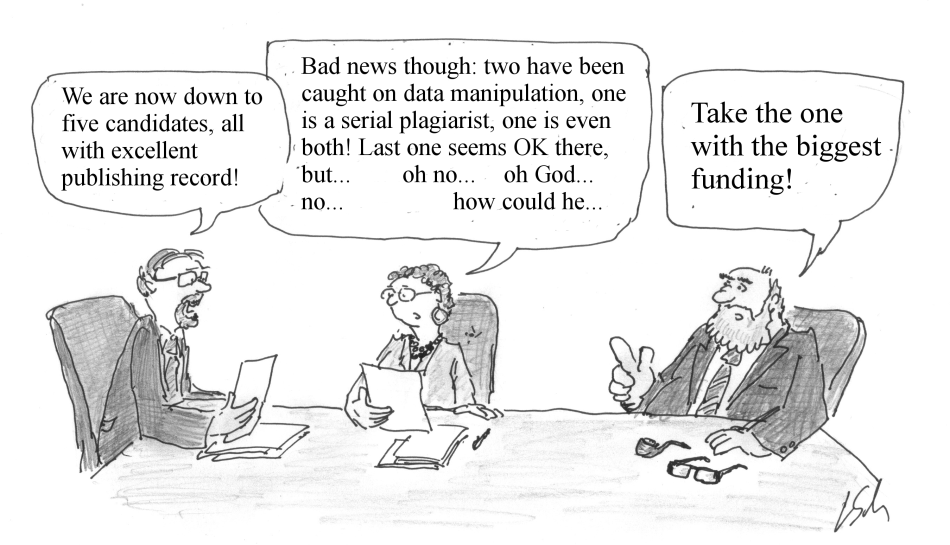
Image result for cartoons stem cell fraud
Cartoon by Johan Thyberg from "For Better Science"
The New York Times this week published a piece about how the lust for success could be corrupting science in a greater way. 

The questions it raises have particular relevance in the stem cell field, which is still very much in a formative stage. 

Aaron Carroll, a professor of pediatrics at the University of Indiana, produced the opinion piece for the Times. He wrote, 
"How might grant funding and career advancement — even the potential for fame — be biasing researchers? How might the desire to protect reputations affect the willingness to accept new information that reverses prior findings?"
He also said, 
"Moves toward open science, and for a change in the academic environment that currently incentivizes secrecy and the hoarding of data, are perhaps our best chance to improve research reproducibility Recent studies have found that an alarmingly high share of experiments that have been rerun have not produced results in line with the original research."
Questions arise with some regularity about hype and fraud in stem cell research. Back in 2014, bioethicist Art Caplan asked, “Why so Much Fake, Unduplicable Stem Cell Research?”

Just this past fall, a multimillion-dollar stem cell research scandal involving Harvard surfaced once again in the news.

Credibility, of course, is everything in science. For the California stem cell agency, it is a matter of survival. It will be out of cash for new awards in less than 12 months and is hoping voters will then give it an additional $5 billion.  More news about stem cell hanky panky, wherever it occurs, will not serve the agency well when it makes its pitch once again to the people of the Golden State.  

Search This Blog